Repositioning cruises are one-way voyages that move a ship from one cruising region to another as the seasons change. They happen mainly in spring and autumn, often cross an ocean, and usually offer more sea days and a lower price per night than a standard round trip. This guide covers the main routes, real examples announced for 2027, how to compare prices, and how to plan the journey home.
In this guide
If you’re completely new to the idea, start with our short explainer: what is a repositioning cruise?
Repositioning cruises in brief
- When: mostly March to May and September to November, as ships move between summer and winter regions.
- Where: across the Atlantic, through the Panama Canal, across the Pacific, or between European seas.
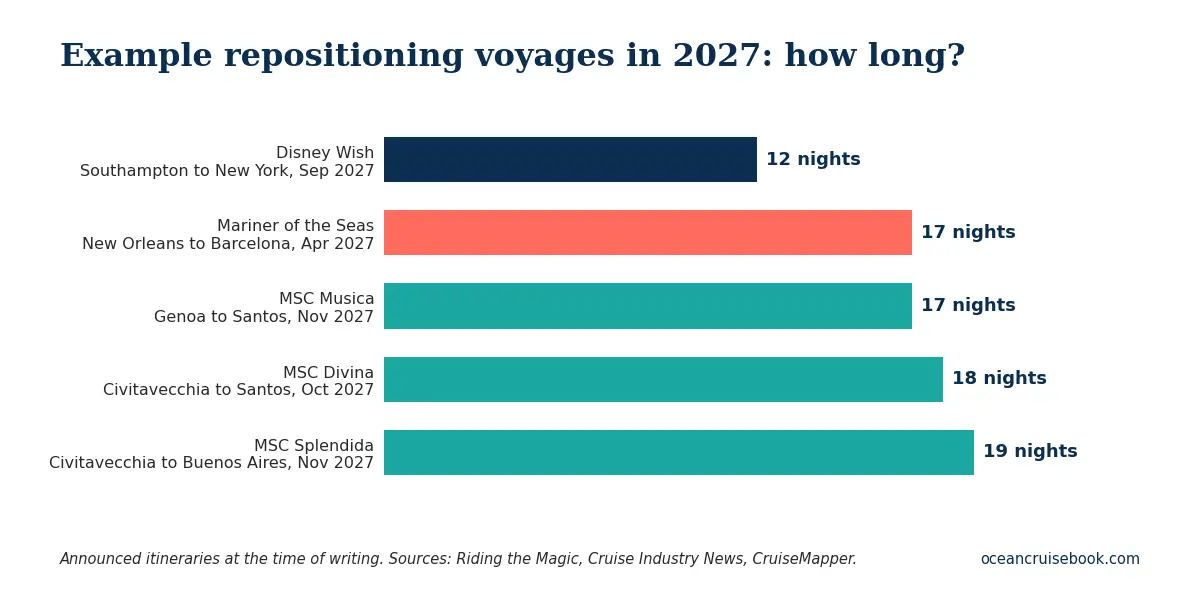
- How long: from a few nights to three weeks or more. The 2027 examples below run from 12 to 19 nights.
- Who they suit: people who love sea days, have time to spare and don’t mind arranging travel for one leg.
The main repositioning routes
Europe to the Americas (and back)
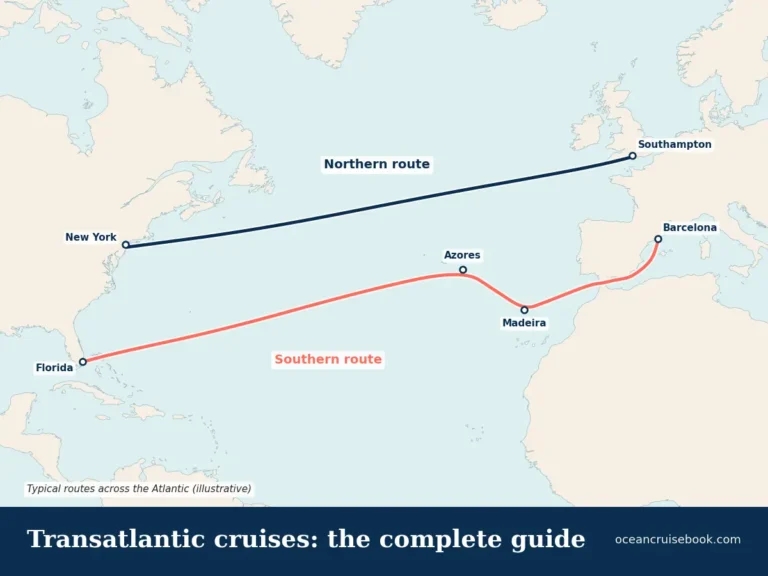
The busiest pattern of all. In autumn, ships leave the Mediterranean and Northern Europe for the Caribbean, Florida and the Gulf of Mexico. In spring, they cross back. Typical routes run from Florida to Barcelona or Rome (Civitavecchia), or from Miami to Lisbon or Barcelona, with crossings often lasting around two weeks.
Our transatlantic cruises guide covers the crossing itself in detail, from sea days to clock changes.
Europe to South America
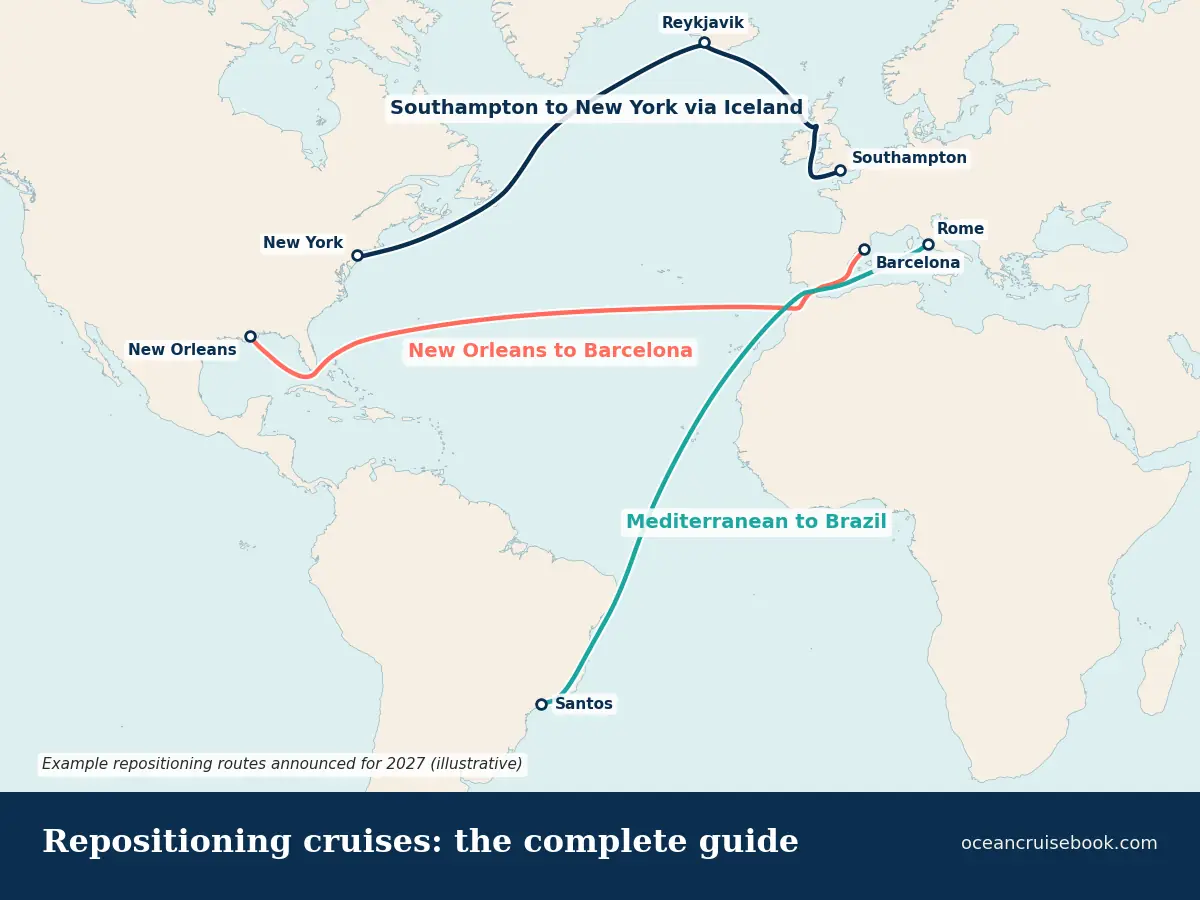
Some lines spend the European winter in Brazil and Argentina, where it’s summer. MSC Cruises, for example, has announced several crossings from Italy and Spain to Santos in Brazil and Buenos Aires in Argentina for October and November 2027.
Through the Panama Canal
Ships moving between Alaska or the US West Coast and the Caribbean often sail through the Panama Canal, which makes these voyages popular in their own right.
Across the Pacific
From the US West Coast, ships head to Hawaii, Asia, Australia or New Zealand, and some move between Australia and Asia with island stops along the way.
Within Europe
Not every repositioning cruise crosses an ocean. Some move a ship from the Mediterranean to Northern Europe, or between UK and continental ports, ready for the next season.
Examples announced for 2027
These are real repositioning voyages announced at the time of writing. Dates, ports and prices can change, so check the latest details before booking.
Disney Wish: Southampton to New York
At the end of its first summer in the UK, Disney Wish sails a 12-night westbound crossing from Southampton on 17 September 2027, arriving in New York on 29 September. It calls at Greenock in Scotland, Reykjavik in Iceland (with two days in port) and St John’s in Newfoundland. Fares were advertised from £1,776 per person for an inside cabin, plus taxes, fees and port expenses.
Mariner of the Seas: New Orleans to Barcelona
Royal Caribbean’s Mariner of the Seas has a 17-night transatlantic crossing from New Orleans on 24 April 2027 to Barcelona, calling at Casablanca, Tangier and Málaga. Read our Royal Caribbean review to see what the line is like on board.
MSC Cruises: Mediterranean to South America
MSC’s autumn 2027 crossings include MSC Divina from Civitavecchia to Santos (18 nights, from 29 October), MSC Musica from Genoa to Santos (17 nights, from 6 November) and MSC Splendida from Civitavecchia to Buenos Aires (19 nights, from 16 November). Our MSC Cruises review explains what to expect from the line.
Spring 2027 crossings to the Mediterranean
Spring crossings from Florida to Europe are announced by several lines each year. For spring 2027, ships named on these routes include Celebrity Ascent and Celebrity Xcel, Holland America’s Nieuw Statendam (Fort Lauderdale to Rotterdam), Virgin Voyages’ Resilient Lady (Miami to Barcelona) and Azamara Journey (Miami to Lisbon).
Are repositioning cruises good value?
Often, yes, when you compare the price per night. Cruise lines have to move the ship anyway, and long runs of sea days are harder to sell than port-packed itineraries, so daily fares can be lower than on a regular cruise.
But a low price per night isn’t the same as a cheap holiday. A 17-night crossing can still cost more in total than a 7-night Mediterranean cruise. Before you book, add up:
- the cruise fare and any taxes, fees and port expenses;
- a one-way flight home (or out), which can cost more than half a return;
- a hotel night before or after, plus transfers;
- gratuities, drinks, Wi-Fi and travel insurance for the full trip.
Then divide by the number of nights and compare like with like.
Planning the journey home
Getting back is the part that needs the most thought.
- Start or finish in the UK if you can. A crossing that begins in Southampton, like the Disney Wish voyage above, means you only need a flight for one direction.
- Price flights before the cruise. Look up one-way and “open-jaw” options (flying into one city and home from another) before you commit.
- Consider a fly-cruise package. Some fares include flights and transfers, which can make the sums simpler and protect you if things change.
- Leave a buffer. Ships can arrive late after rough weather, so avoid booking a tight flight on the morning you disembark.
- Check entry rules. UK travellers usually need an approved ESTA or a visa to enter the United States, and some other countries need visas too. Check GOV.UK for every country on the itinerary.
Choosing the right repositioning cruise
- Pick the season. Spring crossings head towards Europe and Alaska; autumn crossings head towards the Caribbean, South America and warmer waters.
- Decide how many sea days you want. A direct crossing may have six or seven sea days in a row. Routes with island stops, like Madeira, the Azores or Iceland, break the voyage up.
- Choose the ship for the sea days. You’ll spend most of your time on board, so pick a line whose entertainment, dining and atmosphere you’ll enjoy for two weeks or more. Our cruise line reviews, including Cunard and Princess, are a good place to start.
- Look at cabins carefully. On a long voyage a window or balcony makes a real difference, and a mid-ship cabin on a lower deck usually feels the least movement.
- Read the small print. Check what’s included, the cancellation terms and the visa rules for each port.
Packing for a repositioning cruise
- Layers: you may start in a Mediterranean spring and finish in a cool North Atlantic, or the other way round.
- Evening wear: longer voyages usually include several formal or dress-up nights.
- Entertainment for sea days: books, an e-reader or downloaded films, because Wi-Fi at sea can be slow or costly.
- Medicines: enough for the whole trip, plus anything your pharmacist or GP recommends if you’re prone to seasickness.
Repositioning cruise FAQs
When are repositioning cruises announced?
Usually well in advance, often more than a year ahead, alongside each line’s seasonal programme. Some of the 2027 voyages above went on sale in 2026.
Can you get last-minute deals on repositioning cruises?
Sometimes. Because long crossings can be harder to fill, prices may drop closer to departure. If you want a specific cabin, though, booking early is safer.
Do repositioning cruises leave from the UK?
Some do. Lines that spend the summer in Southampton often start or end their season with a one-way voyage to or from North America, like Disney Wish in September 2027.
Are repositioning cruises suitable for families?
They can be, but many sail during school term time and have lots of sea days, so they tend to suit adults, couples and retired travellers best.
Sources and further reading
- Riding the Magic: Disney Wish to sail Southampton to New York via Iceland in 2027
- Cruise Industry News: Royal Caribbean swaps ships for 2027 season in Southampton
- CruiseMapper: MSC Cruises opens sales for 2027–2028 transatlantic repositioning voyages
- Cruisebound: Mediterranean repositioning cruises, spring 2027
- GOV.UK: Foreign travel advice
Found this useful?
Share it with someone planning a cruise.
Got a question?
Need help choosing a cruise?
Message us on WhatsApp and we'll reply as soon as we can.